
listen about me
Scientific Classification
Kingdom: Plantae
Division: Angiospermae
Class: Magnoliopsida
Order: Rosales
Family: Moraceae
Genus: Artocarpus
Species: heterophyllus
Scientific name: Artocarpus heterophyllus Lam.
PHANAS
Botanical Name: Artocarpus heterophyllus Lam.
Family: Moraceae
Common Name: English: Jackfruit, Jackfruit tree; Hindi: कटहल Katahal, कठल Kathal; Marathi: फणस Phanas; Tamil: பலா Palaa; Malayalam: ചക്ക Chakka; Sanskrit: पनसम्
Panasam
Distribution:
Jackfruit is indigenous to the rainforests of the Western Ghats in India. It has since been widely distributed and naturalized throughout tropical and subtropical
lowlands across the globe, spanning regions from South and Southeast Asia to Oceania,
Central and East Africa, Brazil, and the Caribbean
Description:
Habit & Habitat: It grows as an evergreen tree that has a relatively short trunk and dense treetop. It easily reaches heights of 9 to 21 m and trunk diameters of 30 to 80 cm. It sometimes forms buttress roots. The bark of the jackfruit tree is reddish-brown and
smooth. In the event of injury to the bark, a milky sap is released.
Leaves: The leaves are alternate and spirally arranged. They are gummy and thick and are
divided into a petiole and a leaf blade. The petiole is 2.5 to 7.5 cm long. The leathery leaf blade is 20 to 40 cm long and 7.5 to 18 cm wide, and is oblong to ovate in shape.
Flowers: The inflorescences are formed on the trunk, branches or twigs (cauliflory).
Jackfruit trees are monoecious, having both female and male flowers on a tree. The
inflorescences are pedunculated, cylindrical to ellipsoidal or pear-shaped, to about 10–12 cm long and 5–7 cm wide. Inflorescences are initially completely enveloped in egg-shaped cover sheets which rapidly slough off. The individual and prominent stamens are straight with yellow, roundish anthers. Pollen grains are tiny,
around 60 microns in diameter. After the pollen distribution, the stamens become ash-gray
and fall off after a few days. Later, all the male inflorescences also fall off. The greenish female flowers, with hairy and tubular perianth, have a fleshy flower-like base. The female
flowers contain an ovary with a broad, capitate, or rarely bilobed scar. The blooming time ranges from December until February or March.
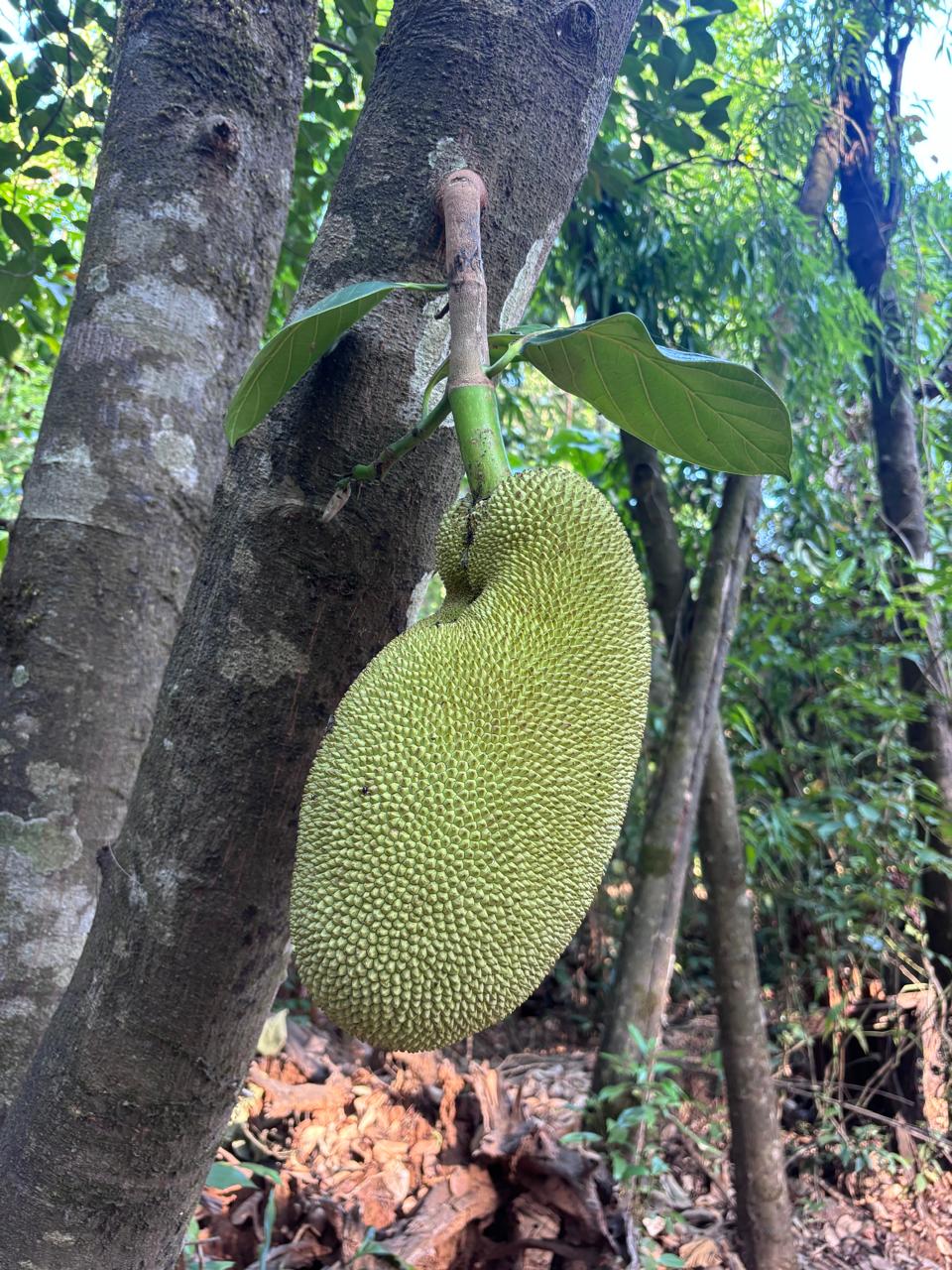
Fruit: The ellipsoidal to roundish fruit is a multiple fruit formed from the fusion of the
ovaries of multiple flowers. The fruits grow on a long and thick stem on the trunk.
Uses:
1) Ripe jackfruit is naturally sweet, with subtle pineapple- or banana-like flavor. It can
be used to make a variety of dishes, including custards, cakes. For the traditional
breakfast dish in southern India, idlis , the fruit is used with rice as an ingredient and
jackfruit leaves are used as a wrapping for steaming.
2) The seeds from ripe fruits are edible once cooked, and are said to have a milky,
sweet taste often compared to Brazil nuts. They may be boiled, baked, or roasted.