
listen about me
Scientific Classification
Kingdom: Plantae
Division: Angiospermae
Class: Dicotyledonae
Subclass: Polypetalae
Series: Calyciflorae
Order: Myrtales
Family: Myrtaceae
Genus: Syzygium
Species: cuminii
Scientific Name: Syzygium cuminii (L.) Skeels
BHEDAS JAMBHUL
Botanical Name: Syzygium haemisphericum (Wight) Alston
Family: Myrtaceae
Common Name: English: Hemispheric rose-apple; Marathi: Bhedas Jambhul
Distribution:
It is native to the Indian subcontinent and Southeast Asia, including Myanmar, Sri Lanka, Bangladesh and the Andaman Islands
Description:
Habit: An aromatic tree that grows from 15 to 30 meters tall in semi-evergreen to evergreen forest. The bark is typically smooth to slightly scaly, ranging from greyish-brown to reddish-brown.
Leaves: Simple, opposite and leathery. They are elliptic or lanceolate, glossy dark green on the top, and paler underneath with pellucid or translucent gland dots; Petiole grooved, hairless. Leaf lamina is elliptic, inverted lanceolate with long pointed or with blunt apex.
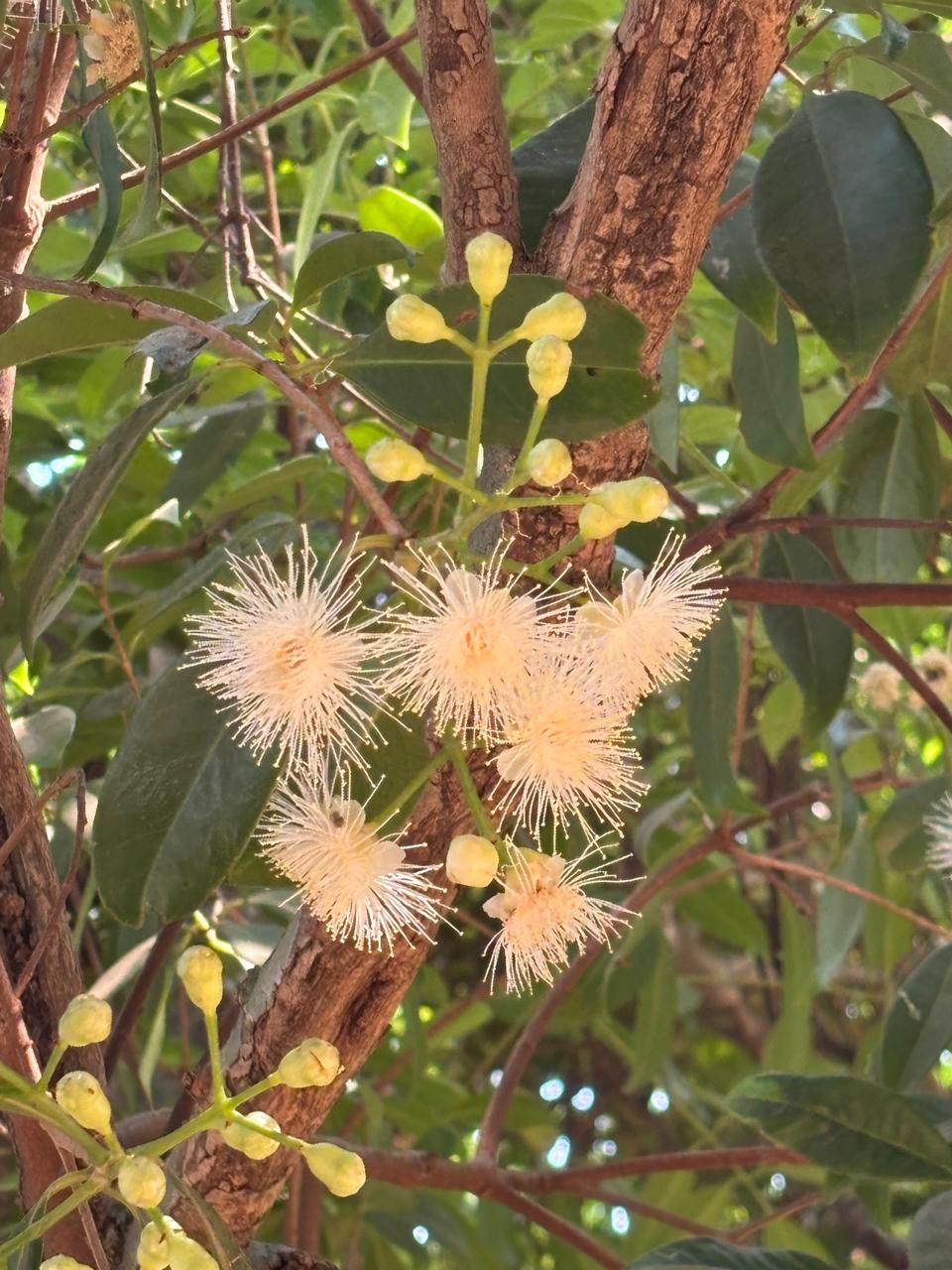
Flowers– are large, white, powder-puff like, growing in terminal or axillary clusters.
Floral stalks are 0.5 cm long. Sepal tube is obconic. Berry is 2-2.5 cm across,
hemispherical, purple, crowned by sepals.
Fruit: A fleshy, hemispherical, or globose berry. It turns from green to yellowish green when ripe. Fruits having persistent calyx lobes.
Uses: Highly valued in traditional folk medicine, its bark, leaves, and berry pulp are widely utilized in Ayurvedic practices for respiratory and digestive support, cellular protection, and topical remedies.
Ecological Importance– It stabilizes riparian zones, supports local biodiversity by providing nectar and fruit for wildlife, and aids in forest carbon sequestration. The flowers produce nectar that attracts various pollinators like insects and small birds, while the fleshy berries
serve as a crucial food source for frugivorous birds, mammals, and local insects.