
listen about me
Anjani
Botanical Name: Memecylon umbellatum Burm. f.
Family– Melastomataceae
Common Names: Anjani or Alli, Anjan, Ollayakudi, Kaya, Kaannaav, Ironwood
Scientific Classification
Kingdom: Plantae
Clade: Angiosperms, Eudicots, Rosids
Order: Myrtales
Family: Melastomataceae (Melastome family)
Subfamily: Olisbeoideae
Genus: Memecylon
Species: umbellatum
Distribution:
Widely distributed across the Indian subcontinent, commonly found in the
Western Ghats, the coastal regions of the Deccan especially in lateritic soil and plateau
areas.
Description:
Habit & Habitat: Grows as a large shrub or small tree, reaching 5 to 15 meters in height.
Leaves: Simple, opposite, and leathery or coriaceous. They are generally ovate-oblong or elliptic, bright to dark green, and glossy. Leaf margin has unique golden margin.
Stem: The branches are dense and covered in smooth, whitish to grayish-brown bark. Bark
has unique vertical lines in young branches and becomes peeling in older trees. The wood
is exceptionally hard and heavy.
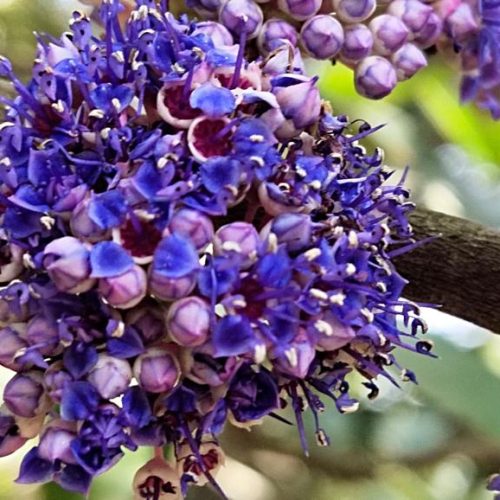
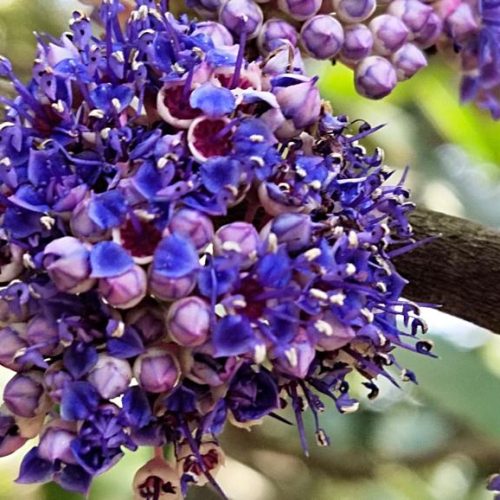
Flowering: The most striking feature of the plant. The brilliant, deep blue sometimes almost
purplish flowers grow in compact, sessile, or short-peduncled cymose umbels. They bloom directly
from the branches and twigs, creating a spectacular carpet-like dusting of blue and mauve as the
petals fall in early floral stage.
Fruits: Globose, small berries (about 7-9 mm across). They transition in color as they ripen,
shifting from yellowish-green to a vibrant red, and finally maturing into a deep bluish-black.
Uses: Dyes: The leaves are famously rich in a yellow glucoside dye. Historically, this has been used to
color the saffron/yellow robes of Buddhist monks and to tint traditional reed mats in regions like Sri Lanka and India.
Medicinal: Every part of the plant is used in traditional Ayurvedic and Siddha remedies. The roots
are utilized for their spasmolytic and pain-relieving properties, while leaf extracts are used to treat
eye ailments, bruises, and skin issues like pimples. Modern lab studies have noted its antioxidant,
antimicrobial, and hypoglycemic (anti-diabetic) properties.
Wood: Because of its immense density and durability, the wood was traditionally used in small-
scale boat and dwelling construction, walking sticks, and axe handles.
Ornamental: Due to its profuse and dazzling flowering habit, the Ironwood tree is increasingly
recognized as a beautiful ornamental addition to tropical gardens and parks